This is apparently a post about a pronoun
It is a fairly frequent experience of late that I turn on a podcast or read an article or flip open a book — it’s usually a podcast, but occasionally it arises elsewhere; for example, try every other book in the nonfiction section — and someone begins pontificating on, basically, all of us. What we are doing, or more accurately, what we are not doing well. How far away we are from nature, or how little we slow down and pay attention to the world around us, or what we need to do to stop being so disconnected, both in general and from one another. And also how overly digitally connected we all are and how we have to stop that. And overall, how much we have to do to get this society to a better place, all of us, together.
If it’s not obvious yet, I’ve found it sort of grating.
What? But why? I mean, that sounds nice, right? It’s well-meaning, or seems to be, anyhow. Being in so-called “we mode” has many benefits, some of which you’ve no doubt experienced, so I imagine the effect is meant to be one of unification and inspiration. And because “we” is a unifying word, it draws people into a certain fold, and makes them feel part of whatever perspective is being shared. It simplifies the bridging of the gap between (a) how the average person usually spends their days and (b) what it would be nice for the average person to do instead.
As a rhetorical device, this is understandable. And still, it’s been bothering me — even when it comes from someone I find otherwise interesting and respectable, because usually, that’s exactly who is doing this, and talking about the “we” of it all.
As far as a reason, all I’ve got is that this usage of “we” implies: “Here is what I say that you all need to do instead of what is currently being done. I am already doing it, but I am pretending I don’t, to make it sound like I am one of you and on the same journey.”
Perhaps that is truly the rub. That it is posing as solidarity rather than showing up authentically as the bid for accountability that it is. That it is a push to look out there, rather than inward — when looking inward is what would potentially, in the long run, be more effective for most people.
This is such a microscopic tendency that I doubted it was worth waxing annoyed about, but the more I noticed it, the more I thought about it, and the louder its volume got. Plus, I started watching “Pluribus,” which just takes the cake in terms of being deeply troubled by an intense onslaught of insincere collectivism. I can’t compete with Carol, but I figure if Carol were real, she might approve this message. (Not that Carol is entirely aspirational…she is so dogged, though, and I appreciate that. Manousos, too, can’t forget him.)
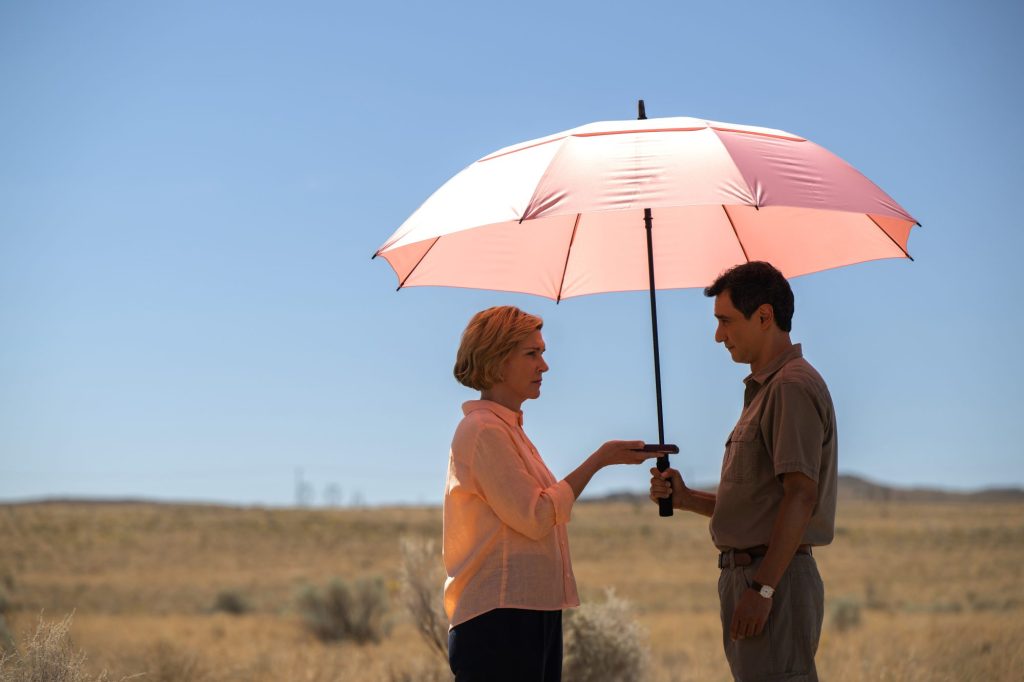
Anyway, what this usage of “we” tells me is that those wanting to guide and alert others — dare I say, wake them up to an issue — believe they must ingratiate themselves to be heard. Sort of like any of the “Others” (once-normal people whose brains have been co-opted by an alien virus, to the uninitiated) in “Pluribus.” This is apparently what is required for the message to be absorbed, and for the listeners to bring themselves to the level of the speaker and think, “Ah yes. That’s true. We do need to change.” Including themselves, and if the speaker can admit as much, why can’t they?
It was tricky to find any other work or writing on this trend, save for this fantastic 2013 article from Pacific Standard, “Why We?” In it, writer Jeremy Gordon maps this back to the original usage of the “royal we,” and in turn calls this modern version “the authorial we.” So many of his turns of phrase speak to its insidious creep and effects incredibly well. Here’s one potent part of his analysis:
Writing in Personal Pronouns in English Language, English professor Katie Wales notes the irony: “‘We’ itself is often used, out of modesty, for example, to resist the egocentricity of a potential ‘I’; yet an egocentric ‘meaning’ will often be re-asserted.” In hiding the individual author, a consensus opinion is born. No one person thinks this thing; we do. And because the entire reason of why you’re reading is because you think the writer has something to say, you’re subconsciously agreeing before you’ve even thought otherwise.
Gordon goes on to call it an “invisible arm around the reader’s shoulder…[a] generalization of every perspective into a monolithic entity.” I was particularly taken with this, from his conclusion:
And that’s the most galling thing: If commonplace usage of “we” is a sign of modernity, it’s also a sign of laziness — a rhetorical trick that’s supposed to breed trust in the person using it, but it also distracts from an absence of ironclad logic. Queen Victoria didn’t have to convince anyone of her right to speak for everyone — after all, that was kind of her job — but the rest of us (ahem) should be a little more careful.
So, in the end, does this accomplish the opposite of spurring action? As in, perhaps it leads many listeners to nod their heads in agreement and believe they are not the problem OR part of the solution. If this authoritative, not-so-royal “we” invites unearned trust, perhaps if the people hearing it internalize these moral points of view and then move on with their lives — saying to themselves, “I understand, so that makes me better than those who don’t.”
Well, okay, obviously not exactly like that. But I imagine you know what I mean and have even done something similar. It is quite a human thing to do. “The average person thinks he isn’t,” and so forth.
Perhaps this is the same line of thinking that makes it easy to post memes/videos/whatever about how horrible The Powers That Be are of late, and casually freak out about it in a way that doesn’t lead to doing much of anything. That is to say, being in a position to angst about how Those People are the problem and will never be held accountable is a position of privilege — one that is a slippery slope to basically surrendering one’s own accountability, and conceding to conditions staying as they are.
Because, yes, there are so many things that none of us has the power to control, and there are many awful things being done in the name of many an awful -ism — not to mention just plain old traditional power/money grabs and grifts. After last week, there’s scarcely any need to preach about that.
Yet there is still so much each of us can do anyway. And maybe it begins with not abiding by the rule of “we.”
That might sound ridiculous at first glance, i.e., how much could that possibly matter? But I think it might be true. Especially because, on top of these calls for “us” to change, I have also never heard more bids for so-called “community” than in recent months. I’d almost say it’s becoming something of a buzzword.
And that seems like another version of the same problem.
Why? Because “community” is not a buzzword. It is not just an abstract concept. It is deeply valuable and meaningful, and even biologically necessary. People are craving it because of this, and therefore it is not — cannot be — a trend. You can use the phrase “third place” to market your business all you like, but that doesn’t matter unless that’s really what it is.
Maybe that’s the core of all of this. That language matters, and says a lot about where a culture stands, and this particular usage of it shrouds the reality that so many people are already creating spaces and art and words that make life even a little bit better for everyone. So many groups are working to help others survive and live well. So many are inspiring action and hope, and providing platforms for meaning.
And then there are the people who do little things, every day, to slow down and defy the capitalistic structures that tend to define much of American culture. Those who do their best to stay connected to others and value their relationships. Who do in fact listen to nature and try to abide by what it’s saying, however imperfectly.
These people are creating real community and hope and inclusion, all of it stronger than the posturing, fake version that this authorial “we” asserts.
Maybe it’s challenging to admit that there isn’t one way to do any of these things, and that the idea of them happening perfectly is just that — an idea — and to see that there will likely be no swelling moment of change wherein everyone tries doing it the same way anyway. But maybe that’s challenge that needs to be faced now.
Even with the horrors of the last several weeks, I doubt most of us truly needs another loud speech or diatribe about how we all need to change. I don’t believe that’s what spurs that on, anyhow. What I imagine many of us need — notice I didn’t say definitively “we need,” aha — is the fire to keep going. To be accountable to those in one’s sphere of living. And more than that, a vision of tomorrow — the sense that it’s all leading somewhere. That each individual person’s action matters and, yes, is part of a whole, but cannot only disappear into that whole. Because on a deep level within is where the good stuff really happens: the inner work, and the growth and earned insights that are its reward.
I can’t think of a better way to close this than with the one poem that has summarized every culturally-concerned thought and feeling that’s kicked my ass lately. It’s one by Langston Hughes that operates on “you” and “I,” and is far better and more meaningful and more beautiful for doing so.
I am so tired of waiting.
Aren’t you,
For the world to become good
And beautiful and kind?
Let us take a knife
And cut the world in two —
And see what worms are eating
At the rind.
 jen weatherly